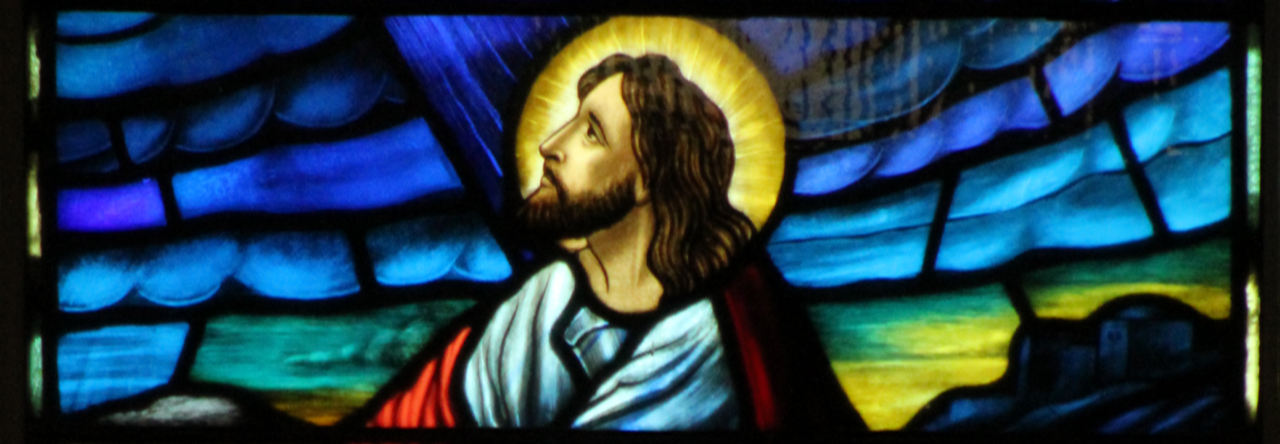
Jesus the stronger man, who sets us free from sin, death, and the power of the devil.
God’s Word
God’s Word that serves as the foundation for our sermon this morning, is from the Gospel according to St. Luke, chapter 11 (Luke 11:14–28): Jesus casting a demon out of a mute man (Luke 11:14), Jesus teaching about the unclean spirit (Luke 11:24–26), and Jesus’ saying, “Blessed rather are those who hear the word of God and keep it” (Luke 11:28).
Dear brothers and sisters in Christ, grace, mercy, and peace to you from God our Father and from our Lord and Savior Jesus Christ. Amen.
Blessed Is the Mother of Jesus
I suppose I can talk about Christmas a little bit today, because at the end of the reading someone cries out, in effect, “Blessed is Your mother. Blessed is the one who brought You into this world and sustained Your life. How blessed she must be to have a Son like You” (Luke 11:27).
And that is true.
I remember back in Advent, leading up to Christmas, we sang Savior of the Nations, Come a couple of times. One of the verses says:
“In her womb this truth was shown:
God was there upon His throne.”
There is the King of kings and Lord of lords (1 Timothy 6:15; Revelation 19:16), reigning from His throne even as a tiny baby in the womb of the Virgin Mary (Luke 1:31; Luke 1:35).
Blessed indeed was she.
But Jesus teaches that there was an even greater blessedness in Mary before that, and along with that: she heard the Word of God and kept it (Luke 11:28). She believed the promise (Luke 1:45). And then, especially on that day of great trial, when the angel came and told her that she would bear the Son of God by the Holy Spirit (Luke 1:26–35), she said, “Let it be to me according to your word” (Luke 1:38). Let my life be according to Your Word, O Lord.
The Strong Man and His Palace
That brings us to the rest of the story.
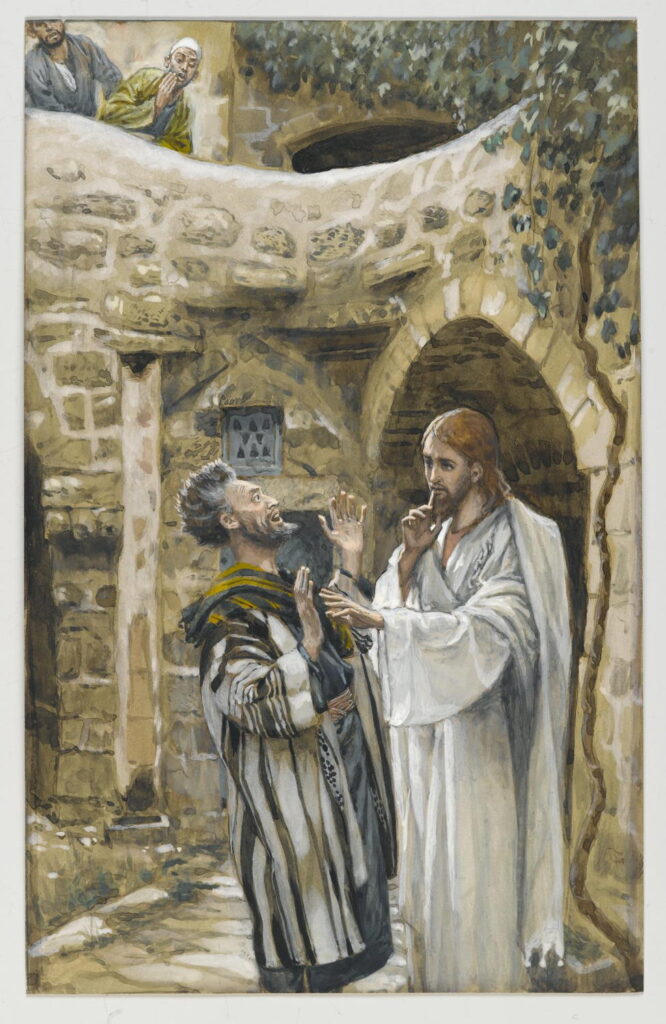
After Jesus casts the demon out of the mute man (Luke 11:14), they accuse Him of driving out demons by Beelzebul (Luke 11:15). Then Jesus teaches them about Satan, the strong man fully armed who guards his own palace (Luke 11:21).
Think about what that palace is in this picture.
Jesus is talking about a demon dwelling in a man (Luke 11:14). He is talking about Satan taking up residence and claiming a palace and sitting on a throne (Luke 11:21). He is talking about the heart. He is talking about the place where God should rightly reign in our lives, and yet someone else is there.
The Many Ways Evil Afflicts
In the Gospels, sometimes it is dramatic and terrifying. A child is thrown into the fire or into the water (Mark 9:17–22). Sometimes it is wild and violent, like the man living among the tombs (Mark 5:1–5). Sometimes it is quieter, stranger, less outwardly spectacular, like this man who simply cannot speak (Luke 11:14).
There are all kinds of ways these things afflict people.
We may not often see the more dramatic forms in our own day, but something like this mute spirit is not hard to recognize. How often are there moments when thanks should be spoken to God, and yet we are silent? Moments when we should call upon Him in trouble, and we do not (Psalm 50:15)? Moments when someone near us is hurting and needs a word of truth, comfort, confession, or love, and yet we cannot seem to speak (Ephesians 4:15; Ephesians 4:29)? Moments when God’s truth ought to be said in the world, and yet our mouths remain closed (Matthew 10:32; 1 Peter 3:15)?
This afflicts whole churches too. It afflicts whole communities. It harms not only us, but those around us.
Who Reigns in the Heart?
And the question Jesus’ words force upon us is this: who is reigning on that throne? Who claims this heart as a palace for his own (Luke 11:21)?
We tend to divide life up into compartments. We separate our “spiritual life” from the rest of life, as though Christ only gets one little piece of us. But St. James speaks about the mouth and says that with it we bless our God and Father, and with it we curse people who are made in the likeness of God (James 3:9). And that ought not to be (James 3:10). The tongue is a little spark, and it can set a great forest ablaze (James 3:5–6).
And it is not just the mouth.
You can ask yourself, from head to toe: how do I use this body, this life, that God has given me (Romans 12:1; 1 Corinthians 6:19–20)? Who is the one reigning in my life?
Think about those moments of temptation. Go back afterward, when you realize what has happened, and ask: where did that begin? When that anger burst out of me, who was reigning there (Galatians 5:19–21)? When I seized up and would not say the good and true thing that needed to be said, who was reigning there (James 4:17)? What temptations lay hold of me (James 1:14–15)? What desires try to claim control (Romans 6:12)? Who is there upon the throne?
Jesus the Stronger Man Who Has Come
But here is the good news:
Jesus does not merely diagnose the problem. He comes to break the power that evil has over us (1 John 3:8). He comes to break the grip that sin and death and the devil have over our lives (Hebrews 2:14–15).
We saw that in the Old Testament reading. God sends Moses to Pharaoh and says, “Let My people go” (Exodus 5:1). And God does not wait around to see whether Pharaoh feels like obeying. He lets His people go whether Pharaoh wants to or not (Exodus 12:29–32; Exodus 12:51).
So also here.
Jesus says, in effect: there is one stronger than the strong man (Luke 11:22). There is one stronger than the devil who sits in your heart and would keep you from God. “I will come. I will break those chains. I will come and set you free” (Luke 4:18; John 8:36).
“A stronger man comes upon him and overcomes him, and he takes away his armor in which he trusted and divides his spoil” (Luke 11:22).
This is what Jesus has come to do.
This is the victory He wins. He tramples the serpent’s head for our sake (Genesis 3:15). He goes to the cross to pay for your sin (1 Peter 2:24; Colossians 2:13–14). He cries out, “It is finished” (John 19:30), and that is your victory. That is your salvation (Colossians 2:15; 1 Corinthians 15:57).
An Empty House Is Not Enough
Jesus also teaches us, though, that as long as we live in this world, the struggle remains. The devil still prowls around like a roaring lion, seeking someone to devour (1 Peter 5:8). The unclean spirit may go out for a time, and if the house is empty, that is a dangerous thing (Luke 11:24–26).
We all know what it is like to find things in our lives that we do not like about ourselves. We know something is wrong (Romans 7:15–20). We know it hurts us and it hurts others. And sometimes that realization gets us a little ways. We try to put things in order.
That is why every January we all make our little lists. “I do not want this in my life anymore. I want this to be better.” And sometimes we do improve a little, for a little while.
But how far does that get us?
How many weeks does that motivation last?
By February, so often it is gone. And sometimes things come back even worse than before (Luke 11:26; 2 Peter 2:20). We say, “I am not going to do this anymore,” but sheer willpower is a weak defense. An empty house is no safety (Luke 11:24–26). If it is only us trying to tidy ourselves up a bit, the old enemy returns and finds an easy place to dwell (Luke 11:25–26).
So we need more than self-improvement.
We need Christ.
We need Him to dwell with us every day (John 15:4–5; Ephesians 3:17).
Blessed Are Those Who Hear the Word
“Blessed rather are those who hear the word of God and keep it” (Luke 11:28).
That is the answer. “In her womb this truth was shown: God was there upon His throne.” And now the Lord would be upon the throne of your heart also (Ephesians 3:17).
What is it to hear the Word of God and keep it (Luke 11:28)?
It is to be in God’s house to hear His Word (Romans 10:17; Psalm 122:1). It is to let your ears be open and your eyes attentive to His kingdom (Matthew 13:16). It is not to let your ears and eyes and heart remain empty, but to let them be filled with His Word (Colossians 3:16). Even the parts that are hard. Even the parts that make you uncomfortable (Hebrews 4:12). Because the things that make you uncomfortable are often the very things you most need to hear (2 Timothy 3:16–17).
He is the King (Psalm 47:7–8). His Word is good (Psalm 19:7–11).
So hear that Word. Believe that Word. Keep that Word (Luke 11:28; James 1:22).
Christ Reigns for You
Because the One who loves you does not come to you in disgust. He did not die for you because He hated you. He did not suffer in your place because He wanted to cast you away. No, the Father loved you (John 3:16). The Son loved you (Galatians 2:20). He loved you so much that He would not leave you in darkness (John 8:12; 1 Peter 2:9).
He sees the good for which God created you (Ephesians 2:10). He desires your life in the light of His presence forever (Revelation 22:3–5). And He is willing to suffer all things to bring you into that life (Hebrews 12:2).
So do not shut Him out (Hebrews 3:15).
He loves you.
And He wants what is best for you (Romans 8:32).
May He sit upon the throne of your heart (Ephesians 3:17). May He guard you and keep you all your days, making you His own (2 Timothy 1:12; Jude 24).
Amen.
And the peace of God, which passes all understanding, keep your hearts and minds in Christ Jesus (Philippians 4:7). Amen.